
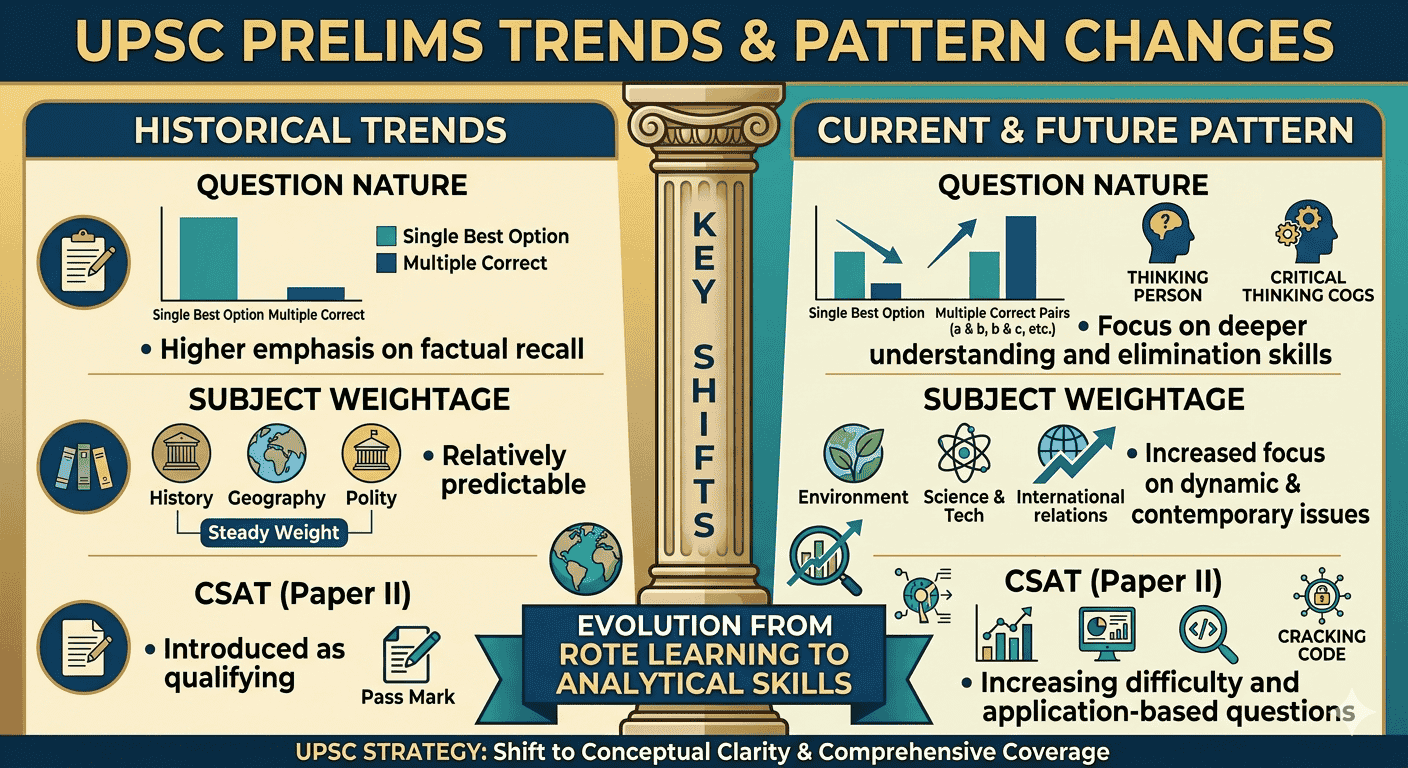

The UPSC Prelims Trends & Pattern Changes are essential for aspirants to understand, as the Civil Services Preliminary Examination has evolved over the years to reflect the changing governance, society, and policy landscape of India. Understanding these UPSC Prelims Trends & Pattern Changes is crucial for planning preparation, prioritizing topics, and strategizing time management effectively for the exam.

Overview of UPSC Prelims Exam 📝
- Exam Name: Civil Services Preliminary Examination
- Conducting Body: Union Public Service Commission (UPSC)
- Papers:
- Paper I: General Studies (GS) – 200 marks
- Paper II: CSAT (Qualifying) – 200 marks
- Negative Marking: 1/3 for wrong answers in Paper I & II
- Time Duration: 2 hours per paper
Key Trends in UPSC Prelims Over the Years 🔍
1️⃣ Shift Towards Analytical Questions 🧠
- Earlier, questions were fact-based.
- Now, questions test understanding, application, and analysis.
- Examples include: linking current affairs with Constitutional provisions, environment, and economy.
2️⃣ Increase in Current Affairs Questions 🗞️
- 40–50% of questions now come from last 12–18 months of national and international events.
- Focus areas:
- Government schemes 💼
- International relations 🌏
- Economic developments 💰
- Science & Technology 🧬
3️⃣ Rise of Interdisciplinary Questions 🌐
- Questions are no longer siloed by subject.
- GS Paper I integrates:
- Geography + Environment
- Polity + Economy
- History + Art & Culture
4️⃣ Emphasis on Policy & Governance 📜
- Direct questions from government policies, acts, and schemes have increased.
- Examples: PM-KISAN, Ayushman Bharat, Digital India initiatives.
5️⃣ Focus on Ethics & Social Issues 👩⚖️
- Questions on gender, social justice, diversity, and ethics are becoming frequent.
- Reflects UPSC’s shift towards real-world governance knowledge.
6️⃣ CSAT Changes 💡
- CSAT is qualifying with 33% marks.
- Focus is on comprehension, reasoning, and decision-making, not rote memory.
- Helps aspirants filter analytical thinkers.
Pattern Changes in Recent Years 🔄
| Aspect | Old Pattern | Current Pattern |
|---|---|---|
| GS Paper I | Mostly static GK/facts | Mix of static + current affairs + analytical questions |
| Topics | History, Geography, Polity, Economy | Same + Environment, Science, Govt Schemes, International Relations |
| Question Type | Direct | Case-based, scenario-based, data interpretation |
| Weightage | History & Polity dominant | Balanced: Polity, Economy, Environment, Science, Culture |
| CSAT | Compulsory, basic aptitude | Qualifying only, 33% marks |
Key Takeaways for UPSC Aspirants 🎯
- Prioritize Current Affairs 📅
- Make monthly notes from newspapers, government reports, and official schemes.
- Practice Analytical Questions 🧩
- Solve previous years’ papers, mock tests, and scenario-based questions.
- Revise Polity & Economy Concepts 💼📜
- Questions often link concepts with current policies.
- Environment & Science cannot be ignored 🌱🔬
- Focus on key initiatives, conventions, and recent discoveries.
- Time Management ⏰
- Allocate 2 hours per paper effectively during preparation and practice tests.
Q1. Has UPSC changed the Prelims pattern recently?
A: Yes, emphasis has shifted towards analytical questions, current affairs, and interdisciplinary integration. CSAT remains qualifying.
Q2. What subjects are now most important for Prelims?
A: Polity, Economy, Environment, Current Affairs, Science & Technology, and History remain key.
Q3. How many current affairs questions are usually asked?
A: Roughly 40–50% of Paper I comes from current affairs of the last 12–18 months.
Q4. Is CSAT still mandatory?
A: CSAT is qualifying, requiring 33% marks, primarily testing reasoning and comprehension.
Q5. How should aspirants prepare for pattern changes?
A: Focus on conceptual clarity, analytical practice, and linking static syllabus with current events. Solve previous years’ papers and take mock tests regularly.