
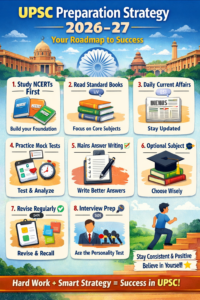

UPSC Preparation Strategy is crucial for aspirants aiming to crack one of the toughest and most prestigious exams in India. The UPSC Civil Services Examination (CSE) attracts lakhs of candidates every year, but with limited vacancies, success demands not just hard work, but smart planning, consistency, and the right strategy 🎯
This article provides a step-by-step UPSC preparation strategy covering Prelims, Mains, and Interview, keeping in mind the latest exam trends and challenges.
📌 Understanding the UPSC Exam Structure (First Step)
Before starting preparation, it is very important to understand the exam pattern 👇
🔹1: Preliminary Examination (Objective)
- General Studies Paper I
- CSAT (Qualifying)
🔹 2: Mains Examination (Descriptive)
- 9 Papers (Essay, GS I–IV, Optional Papers, Language Papers)
🔹 3: Personality Test (Interview)
👉 One mistake many aspirants make is preparing without understanding how these stages are interconnected.
🧭 UPSC Preparation Strategy (Stage-wise)
🟢 1. Foundation Building (First 6–8 Months)
This phase is crucial, especially for beginners.
📚 Focus on NCERTs (Class 6–12)
NCERT books are the backbone of UPSC preparation 📖
They help in:
- Building basic concepts
- Understanding simple language
- Creating a strong foundation
Subjects to focus on:
- History 🏺
- Geography 🌍
- Polity ⚖️
- Economy 💰
- Environment 🌱
👉 Read NCERTs 2–3 times instead of rushing to advanced books.
🟢 2. Standard Reference Books (Core Preparation Phase)
Once basics are clear, move to standard books.
📘 Subject-wise Approach:
- Polity – Focus on Constitution, governance, current issues
- History – Ancient, Medieval, Modern + Culture
- Geography – Physical + Indian geography
- Economy – Concepts + current economic developments
- Environment – Static + current environment issues
- Science & Tech – Applied and current-based topics
📌 Golden Rule:
Don’t read too many books. Read limited books multiple times 🔁
🟢 3. Current Affairs Strategy (Daily Habit) 📰
For UPSC 2026–27, current affairs are extremely important.
✅ How to Prepare Current Affairs:
- Daily newspaper reading (1–1.5 hours)
- Monthly current affairs notes
- Link news with syllabus topics
📌 Focus areas:
- Government schemes
- International relations 🌐
- Economy & Budget
- Environment & climate change
- Science & technology developments
👉 Make short notes in your own words ✍️
🟢 4. Prelims-Oriented Strategy (Accuracy Matters 🎯)
Prelims is all about:
- Concept clarity
- Elimination techniques
- Time management
🧠 Tips for Prelims:
- Practice MCQs regularly
- Analyze mock tests properly
- Focus on weak areas
- Revise static subjects again and again
📌 CSAT Warning:
Never ignore CSAT ❗ Many good candidates fail because of overconfidence.
🟢 5. Mains Answer Writing Strategy ✍️
Mains is the real game-changer.
🧾 How to Improve Answer Writing:
- Practice daily or alternate days
- Write answers in a structured format
- Use:
- Headings & subheadings
- Diagrams & flowcharts 📊
- Examples and case studies
🕒 Time management is key:
- 150 words → 7–8 minutes
- 250 words → 10–11 minutes
👉 Quality answers matter more than quantity.
🟢 6. Optional Subject Strategy 🎓
Choosing the right optional is very important.
🔍 How to Choose Optional:
- Interest in subject ❤️
- Availability of resources
- Overlap with GS syllabus
- Previous years’ performance
📌 Complete optional syllabus before Prelims, if possible.
🟢 7. Revision Strategy (Most Ignored but Most Important 🔁)
Without revision, everything fades.
🔄 Ideal Revision Plan:
- First revision → within 7 days
- Second revision → within 1 month
- Final revision → before exam
👉 Use:
- Short notes
- Mind maps 🧠
- Sticky notes
🟢 8. Mock Tests & Analysis 📊
Mock tests help you:
- Understand exam temperament
- Improve speed and accuracy
- Reduce exam fear 😌
📌 Important:
Attempting mocks is useless without proper analysis.
🟢 9. Mental Health & Discipline 🧘♂️
UPSC preparation is a marathon, not a sprint.
💡 Stay Mentally Strong:
- Follow a realistic timetable
- Take short breaks
- Avoid comparison with others
- Trust your journey ✨
👉 Consistency beats motivation.
🟢 10. Interview Preparation (Personality Test) 🎤
Interview tests:
- Personality
- Honesty
- Decision-making ability
🗣️ Tips:
- Be confident, not arrogant
- Know your DAF thoroughly
- Answer honestly
- Practice mock interviews
🏁 Final Words: Believe in the Process 💪
UPSC 2026–27 is achievable if you:
- Start early ⏳
- Follow a disciplined routine
- Revise regularly
- Stay consistent and positive 🌟
Remember:
Many fail not because UPSC is tough, but because consistency is rare.
❓ Frequently Asked Questions (FAQs)
🔹 Q1. When should I start preparing for UPSC 2026–27?
Answer:
Ideally, start 12–15 months before Prelims. Early starters have more time for revision and answer writing.
🔹 Q2. Is coaching necessary for UPSC?
Answer:
No, coaching is not mandatory. With the right books, guidance, and discipline, self-study is enough.
🔹 Q3. How many hours should I study daily?
Answer:
Quality matters more than hours.
On average:
- Beginners: 6–7 hours
- Serious aspirants: 8–10 hours
🔹 Q4. Can I prepare for Prelims and Mains together?
Answer:
Yes 👍
Integrated preparation is the best approach for UPSC.
🔹 Q5. How important are mock tests?
Answer:
Very important ❗
Mocks help identify mistakes and improve exam performance.