

The Uniform Civil Code: For UPSC Civil Services is one of the most debated topics in Indian polity. It is frequently asked in UPSC Prelims, Mains (GS Paper II), and even in Ethics & Essay papers. Understanding its constitutional basis, challenges, and significance is crucial for aspirants who aim to answer questions effectively and link the topic with current affairs and governance issues.

What is the Uniform Civil Code? 🏛️
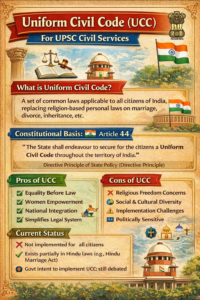
The Uniform Civil Code (UCC) refers to a set of common civil laws that apply equally to all citizens of India, regardless of religion, caste, or community.
Currently, India has personal laws based on religion for issues like:
- Marriage 💍
- Divorce ✂️
- Inheritance & Succession 🏠
- Adoption 👶
The UCC aims to replace these religious-based personal laws with a uniform set applicable to all citizens.
Constitutional Provisions Related to UCC 📜
- Article 44 of the Constitution (Directive Principles of State Policy) states:
“The State shall endeavour to secure for the citizens a uniform civil code throughout the territory of India.”
- Fundamental Rights (Articles 14, 15, 21) support equality and non-discrimination, which align with the idea of UCC.
- UCC is not currently enforceable but is a constitutional goal for the future.
Arguments in Favor of UCC ✅
- Equality Before Law ⚖️
- Ensures all citizens, irrespective of religion, have the same legal rights.
- Women Empowerment 👩⚖️
- Eliminates gender discrimination in personal laws related to marriage, inheritance, and divorce.
- National Integration 🇮🇳
- Promotes a sense of unity by having common laws for all communities.
- Simplification of Legal System 📚
- Reduces confusion arising from multiple personal laws for different communities.
Arguments Against UCC ❌
- Religious Freedom Concerns 🕌✡️
- Critics argue it may violate Article 25 (Freedom of Religion).
- Social & Cultural Diversity 🌏
- India’s communities have distinct traditions and customs, making uniform laws challenging.
- Implementation Challenges ⚠️
- Enforcing UCC nationwide requires careful legislation and consensus.
- Political Sensitivity 🗳️
- Often a controversial topic, with debates between majority and minority groups.
Steps Taken by India Towards UCC 🛤️
- Hindu Code Bills (1955–1956) – First major attempt to codify personal laws for Hindus.
- Law Commission Reports (2018) – Recommended gradual implementation of UCC.
- Supreme Court Judgements – Several PILs have urged Government to implement UCC for equality and justice.
Current Status of UCC in India 🔍
- Not implemented for all citizens.
- Exists partially in Hindu laws (Hindu Marriage Act, Hindu Succession Act).
- Government has expressed intent to implement UCC, but it remains a politically sensitive and debated issue.
Importance of UCC for UPSC Aspirants 🎯
- Polity & Governance (GS Paper II)
- Questions on Directive Principles, Fundamental Rights, and Personal Laws.
- Ethics & Integrity (GS Paper IV)
- Discusses gender justice, equality, and social reform.
- Current Affairs & Essays
- Often in news due to government proposals or Supreme Court PILs.
- Interview Questions
- Aspirants may be asked opinions on UCC and religious freedom.
📌 Conclusion
The Uniform Civil Code is a long-standing goal of the Indian Constitution aimed at equality, justice, and national integration. While it promises social reform and empowerment, its implementation requires careful balancing of constitutional rights and religious sensitivities. For UPSC aspirants, understanding UCC is essential for Polity, Ethics, and Current Affairs preparation.
Frequently Asked Questions (FAQs) ❓
Q1. What is the difference between Personal Laws and UCC?
A: Personal laws are religion-specific, while UCC is a common set of laws applicable to all citizens irrespective of religion.
Q2. Which Article of the Constitution talks about UCC?
A: Article 44 of the Directive Principles of State Policy mentions UCC.
Q3. Has UCC been implemented in India?
A: Not yet. Only Hindus have codified personal laws. UCC for all religions is still under discussion.
Q4. How does UCC promote gender equality?
A: It ensures equal rights for women in marriage, inheritance, and divorce, removing discriminatory practices in certain personal laws.
Q5. Why is UCC controversial?
A: It may affect religious freedom, cultural diversity, and is politically sensitive, leading to debates on implementation.