
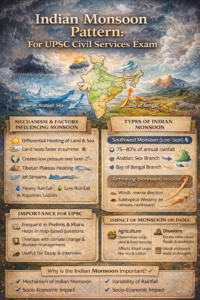

The Indian Monsoon Pattern: For UPSC Civil Services Exam is one of the most important topics for aspirants, especially in Geography (GS Paper I) and Environment & Disaster Management (GS Paper III). It strongly influences India’s climate, agriculture, water resources, economy, and livelihoods, making it a high-priority area for both Prelims and Mains. 📚
A clear understanding of the mechanism, types, factors, and impacts of the Indian monsoon helps aspirants write analytical and well-structured answers in the examination.

🌍 What is the Indian Monsoon?
The Indian Monsoon refers to the seasonal reversal of winds that brings rainfall to the Indian subcontinent. It occurs due to differential heating of land and sea, resulting in the movement of moisture-laden winds.
🔹 The word monsoon is derived from the Arabic word “Mausim”, meaning season.
☀️ Factors Responsible for Indian Monsoon
Several climatic and geographical factors influence the Indian Monsoon:
1️⃣ Differential Heating of Land and Sea
- Land heats faster than sea in summer ☀️
- Creates low pressure over India and high pressure over oceans
2️⃣ Shift of Inter-Tropical Convergence Zone (ITCZ)
- ITCZ shifts northward during summer 🌍
- Attracts moisture-laden winds towards India
3️⃣ Tibetan Plateau Heating
- Acts as a heat source
- Strengthens monsoon circulation
4️⃣ Jet Streams
- Tropical Easterly Jet enhances monsoon rainfall ✈️
- Subtropical Westerly Jet retreats northward
🌊 Types of Indian Monsoon
🌧️ 1. Southwest Monsoon (June–September)
- Main rainy season
- Accounts for 75–80% of annual rainfall
- Divided into two branches:
- Arabian Sea Branch
- Bay of Bengal Branch
🍂 2. Retreating (Northeast) Monsoon (October–December)
- Winds reverse direction
- Brings rainfall mainly to Tamil Nadu and southeast coast
🗺️ Distribution of Monsoon Rainfall
- Heavy rainfall: Western Ghats, Northeast India 🌧️
- Moderate rainfall: Indo-Gangetic Plains 🌾
- Low rainfall: Rajasthan, Ladakh 🌵
Uneven distribution leads to floods and droughts in different regions.
⚠️ Variability of Indian Monsoon
The Indian Monsoon is highly variable and unpredictable, influenced by:
🌍 El Niño & La Niña
🌡️ Indian Ocean Dipole (IOD)
🌊 Sea Surface Temperature changes
🌪️ Climate change and global warming
🌱 Impact of Indian Monsoon on India
🌾 Agriculture
- Determines crop yield and food security
- Affects Kharif crops like rice and cotton
💧 Water Resources
- Recharges rivers, reservoirs, and groundwater
💰 Economy
- Strong link between monsoon performance and GDP growth
⚡ Disasters
- Excess rainfall causes floods and landslides
- Weak monsoon leads to droughts
📝 Importance of Indian Monsoon for UPSC
✔ Frequently asked in Prelims and Mains
✔ Helps in map-based questions 🗺️
✔ Overlaps with climate change and disaster management
✔ Useful for Essay and Interview
UPSC often asks questions on mechanism, variability, and socio-economic impact of monsoon.
🚀 Conclusion
The Indian Monsoon Pattern is the backbone of India’s climatic system and socio-economic structure. For UPSC aspirants, mastering this topic requires conceptual clarity, diagram practice, and current affairs linkage. A well-prepared monsoon answer reflects analytical depth and geographical understanding, essential for high scores. 🌟
❓ Frequently Asked Questions (FAQs)
Q1. Which monsoon gives maximum rainfall in India?
The Southwest Monsoon provides the maximum rainfall.
Q2. Why is the Indian Monsoon important for agriculture?
It determines crop production, irrigation, and food security.
Q3. What causes variability in the Indian Monsoon?
Factors like El Niño, IOD, jet streams, and climate change cause variability.
Q4. Which areas receive maximum monsoon rainfall?
Western Ghats and Northeast India receive heavy rainfall.
Q5. How is the Indian Monsoon relevant for UPSC?
It is crucial for Geography, Environment, Disaster Management, and current affairs-based questions.