
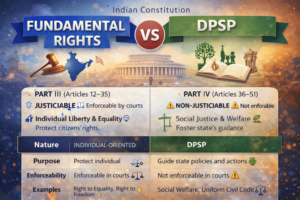

The Indian Constitution provides a unique blend of Fundamental Rights (FRs) and Directive Principles of State Policy (DPSPs) to create a balanced framework for governance. Understanding Fundamental Rights vs DPSP is essential, as both play a critical role in shaping laws, policies, and the rights of citizens, yet they differ significantly in nature, enforceability, and purpose.
Understanding the differences and interlinkages between Fundamental Rights vs DPSP is essential for UPSC aspirants, especially in Polity and Governance (GS Paper II). 📚

🏛️ What are Fundamental Rights (FRs)?
Fundamental Rights are justiciable rights guaranteed to all citizens of India under Part III of the Constitution. They are enforceable by courts, and any law violating them can be declared void.
Key Features of Fundamental Rights:
- Guaranteed under Part III (Articles 12–35)
- Justiciable: Can approach the court for enforcement ⚖️
- Include rights like:
- Right to Equality (Articles 14–18) ✨
- Right to Freedom (Articles 19–22) 🕊️
- Right against Exploitation (Articles 23–24) 🚫
- Right to Freedom of Religion (Articles 25–28) ⛪🕌🕉️
- Cultural & Educational Rights (Articles 29–30) 📚
- Right to Constitutional Remedies (Article 32) 🏛️
Purpose: To protect individual liberty, equality, and dignity of citizens.
📜 What are Directive Principles of State Policy (DPSPs)?
DPSPs are guidelines given to the State to establish a just, equitable, and welfare-oriented society under Part IV of the Constitution. They are not enforceable by courts, but they are fundamental in governance and policy-making.
Key Features of DPSPs:
- Guaranteed under Part IV (Articles 36–51)
- Non-justiciable: Cannot be enforced in a court of law ⚠️
- Include principles like:
- Promotion of Social Welfare and Justice 🌱
- Equal Pay for Equal Work 💼
- Protection of Environment and Forests 🌳
- Promotion of Education and Public Health 🏥📚
- Uniform Civil Code (Article 44) ⚖️
Purpose: To guide the government in creating socio-economic justice and welfare-oriented policies.
🔹 Fundamental Rights vs DPSP: Key Differences
| Feature | Fundamental Rights (FRs) | Directive Principles (DPSPs) |
|---|---|---|
| Nature | Individual-oriented | State-oriented |
| Enforceability | Justiciable; enforceable in courts ⚖️ | Non-justiciable; cannot be enforced in court ❌ |
| Source | Part III of Constitution | Part IV of Constitution |
| Objective | Protect liberty, equality, and dignity of citizens 🕊️ | Promote welfare, socio-economic justice, and governance 🌱 |
| Scope | Legal remedies available | Moral and policy guidelines for the State |
| Example | Right to Equality, Right to Freedom ✨ | Promotion of education, Uniform Civil Code ⚖️ |
🔗 Relationship Between FRs and DPSPs
- Complementary: DPSPs guide policy-making without infringing on FRs.
- Harmonious Interpretation: Courts often try to harmonize FRs and DPSPs when conflicts arise.
- Case Laws: In Kesavananda Bharati (1973) and Minerva Mills (1980), the Supreme Court emphasized that both are fundamental to the Constitution.
💡 Key Idea: FRs protect citizens, DPSPs guide the State, and together they promote a just and democratic society.
🧠 UPSC Tips on FRs vs DPSPs
✔ Focus on Part III and Part IV articles
✔ Understand justiciable vs non-justiciable nature
✔ Memorize key examples for both
✔ Relate current events and government schemes to DPSPs
✔ Mention landmark Supreme Court judgments in answers
🚀 Final Thoughts
The debate of Fundamental Rights vs DPSPs reflects the balance between individual liberty and social justice. UPSC aspirants should understand not only the differences but also the complementary role these constitutional provisions play in shaping India’s governance. 🌟
❓ Frequently Asked Questions (FAQs)
Q1. Are DPSPs enforceable by courts?
No. DPSPs are non-justiciable, but they guide the government in policy-making.
Q2. Can Fundamental Rights be suspended?
Yes, under certain conditions like national emergency, some FRs can be suspended.
Q3. How are FRs and DPSPs related?
FRs protect individuals while DPSPs guide the State. Courts interpret them harmoniously to maintain balance.
Q4. Which is more important for UPSC Mains?
Both are crucial. FRs for direct questions, DPSPs for current affairs and policy linkages.
Q5. Can DPSPs override FRs?
No. FRs are justiciable and cannot be overridden, but some amendments harmonize FRs and DPSPs.