
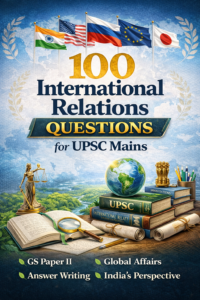

International Relations (IR) is a dynamic and analytical part of the UPSC Mains examination. Covered under General Studies Paper II. It tests an aspirant’s understanding of India’s foreign policy, global politics, diplomacy, international institutions, and world affairs. To strengthen preparation, this article presents 100 International Relations Questions for UPSC Mains covering all key syllabus areas.
Practicing 100 International Relations Questions for UPSC Mains helps aspirants build conceptual clarity, global awareness, and structured answer writing. These skills are essential for scoring well in GS Paper II.
🎯 Why International Relations Is Important for UPSC Mains
✔ Major component of GS Paper II
✔ Strong linkage with current affairs
✔ Frequently asked analytical and opinion-based questions
✔ Helps in Essay and Interview preparation
A solid grip on International Relations allows aspirants to write balanced, mature, and multidimensional answers.
📘 What Do the 100 International Relations Questions Cover?
The 100 International Relations Questions for UPSC Mains are designed to comprehensively cover the entire GS II syllabus, blending static concepts with dynamic developments.
🇮🇳 Section 1: India and Its Neighbourhood
🟢 India–Pakistan relations
🟢 India–China border and strategic challenges
🟢 India–Nepal, Bhutan, Bangladesh relations
🟢 Role of SAARC and BIMSTEC
🟢 Neighborhood First Policy
🟢 Regional connectivity and security issues
🌏 Section 2: India’s Relations with Major Powers
🟢 India–USA strategic partnership
🟢 India–Russia relations
🟢 India–European Union cooperation
🟢 India–Japan and Act East Policy
🟢 India–Africa engagement
🟢 India–Middle East relations
🏛️ Section 3: International Organizations & Groupings
🟢 United Nations and its reforms
🟢 World Trade Organization issues
🟢 IMF and World Bank roles
🟢 BRICS, SCO, G20 significance
🟢 Quad and Indo-Pacific strategy
🟢 ASEAN and regional groupings
⚖️ Section 4: Global Politics & Geopolitics
🟢 Changing world order
🟢 Multipolarity and global power shift
🟢 Geopolitics of Indo-Pacific
🟢 Energy security and geopolitics
🟢 Great power rivalry
🟢 Strategic autonomy of India
☮️ Section 5: Security, Defence & Diplomacy
🟢 National security challenges
🟢 Terrorism and global security
🟢 Cyber security and space diplomacy
🟢 Defence partnerships and agreements
🟢 Nuclear policy and disarmament
🟢 Maritime security
🌱 Section 6: Global Issues & Contemporary Challenges
🟢 Climate change diplomacy
🟢 Human rights and humanitarian interventions
🟢 Refugee and migration crises
🟢 Global health diplomacy
🟢 Technology and global governance
🟢 Environmental agreements
✍️ How Practicing These Questions Helps in Mains
Practicing 100 International Relations Questions for UPSC Mains enables aspirants to:
✅ Structure GS II answers effectively
✅ Link current affairs with theory
✅ Present India-centric viewpoints
✅ Use examples, data, and agreements
✅ Improve analytical depth
🧠 Answer Writing Tips for International Relations
✔ Begin with context or recent development
✔ Mention India’s interests and global impact
✔ Use sub-headings and balanced arguments
✔ Avoid extreme views; maintain diplomacy
✔ End with way forward or policy suggestions
🎓 Final Thoughts
International Relations is not about memorizing facts—it is about understanding global dynamics from India’s perspective. Consistent practice of 100 International Relations Questions for UPSC Mains helps aspirants stay exam-ready, confident, and analytically sharp.
❓ Frequently Asked Questions (FAQs)
Q1. Which GS paper covers International Relations?
International Relations is mainly covered under GS Paper II.
Q2. Are IR questions mostly current-affairs based?
Yes, but they require conceptual understanding along with current events.
Q3. How many IR questions are asked in UPSC Mains?
Usually 3–5 questions appear every year in GS Paper II.
Q4. How can I improve my IR answer writing?
Practice regularly, link answers with India’s foreign policy, and maintain balance.
Q5. Is International Relations important for the Interview stage?
Yes 👍 A strong IR understanding is extremely helpful during the Personality Test.