
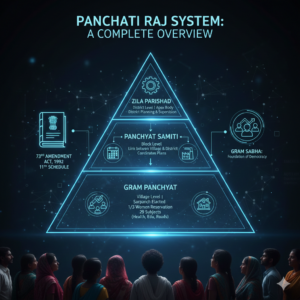

Panchayati Raj System: A Complete Overview explains how this system serves as the backbone of Indian democracy at the grassroots level. It is not merely a method of administration but a profound vision to empower the rural population, ensuring that development reaches the very last person in the village. By shifting power from central and state capitals directly to village assemblies, the Panchayati Raj System has fundamentally transformed the socio-political landscape of India.
In this detailed guide, we will explore the history, structure, significance, and modern challenges of this three-tier system. Whether you are a student, a civil service aspirant, or a curious citizen, this comprehensive overview provides deep insights into the mechanics of local self-governance.
The Historical Evolution of Local Self-Governance in India
The concept of "Panchayat" (an assembly of five elders) is deeply rooted in ancient Indian history. However, the formal Panchayati Raj System we recognize today resulted from decades of committee recommendations and constitutional struggles.
Ancient and Colonial Roots of Rural Administration
In ancient India, villages functioned as self-sufficient units governed by their own councils. The Rigveda mentions 'Sabhas' and 'Samitis' that acted as local decision-making bodies. During the British era, the system was largely neglected until Lord Ripon, often called the "Father of Local Self-Government," introduced the first formal steps toward local representation in 1882. Nevertheless, these early efforts remained limited in scope and power.
Post-Independence Vision and the Balwant Rai Mehta Committee
After independence, Mahatma Gandhi strongly advocated for "Gram Swaraj" (Village Self-Rule), believing that the soul of India resides in its villages. However, the Drafting Committee of the Constitution initially ignored local governments. It was only after a strong debate that Article 40 was added to the Directive Principles of State Policy, urging states to organize village panchayats.
In 1957, the government appointed the Balwant Rai Mehta Committee to examine the Community Development Programme. The committee famously recommended the three-tier Panchayati Raj System:
- Gram Panchayat (Village level)
- Panchayat Samiti (Block level)
- Zila Parishad (District level)
Rajasthan became the first state to adopt this framework in Nagaur on October 2, 1959. This was followed by Andhra Pradesh and other states.
Subsequent Committees and the Road to Constitutional Status
As the system faced issues of irregular elections and lack of funds, several other committees were formed:
- Ashok Mehta Committee (1977): Recommended a two-tier system and political party participation.
- G.V.K. Rao Committee (1985): Highlighted "bureaucratization" of development and suggested making the Zila Parishad the pivotal body.
- L.M. Singhvi Committee (1986): Recommended constitutional status for PRIs to ensure they aren't at the mercy of state governments.
The 73rd Constitutional Amendment Act: A Legal Revolution
The 73rd Amendment Act of 1992 finally granted constitutional status to the Panchayati Raj System, making it a compulsory part of India's democratic fabric. This Act added Part IX to the Constitution (Articles 243 to 243O) and the 11th Schedule.
Mandatory Provisions of the Act
- Gram Sabha: Established the Gram Sabha as the foundation of the system, consisting of all registered voters in a village.
- Three-Tier Mandatory Structure: States with a population over 20 lakh must implement the village, intermediate, and district levels.
- Direct Elections: All members at all levels are elected directly by the people.
- Reservation of Seats: The law mandates seat reservations for SCs and STs in proportion to their population. Crucially, one-third (33%) of all seats are reserved for women.
- Fixed Tenure: Every Panchayat has a fixed 5-year term. If dissolved earlier, elections must be held within 6 months.
- State Election Commission: An independent body to ensure regular and fair elections.
- State Finance Commission: To review the financial position of Panchayats and recommend devolution of funds.
Voluntary Provisions (State Discretion)
State legislatures have the power to decide:
- Granting voting rights to MPs/MLAs in the Panchayats.
- Providing reservations for Backward Classes.
- Devolving powers to prepare plans for economic development and social justice.
Analyzing the Three-Tier Structure of Rural Local Bodies
The Panchayati Raj System operates on a pyramid-like structure that ensures administrative connectivity from the smallest hamlet to the district headquarters.
Gram Panchayat: The Village Level Executive
The Gram Panchayat is the basic unit of the Panchayati Raj System. It acts as the executive body that implements the decisions of the Gram Sabha.
- Composition: Consists of Ward Members (Panches) and a Chairperson (Sarpanch/Pradhan).
- Functions: It handles village sanitation, street lighting, maintenance of village wells/tanks, and primary education.
- Significance: It is the primary interface between the citizen and the government.
Panchayat Samiti: The Intermediate Block Council
The Panchayat Samiti acts as a vital link between the Village Panchayat and the District administration.
- Composition: Includes elected members, Sarpanches of all Panchayats in the block, and often local MLAs/MPs.
- Role: It coordinates the development plans of several Gram Panchayats and supervises agricultural and health programs at the block level.
- Execution: The Block Development Officer (BDO) is the administrative head who works with the elected Samiti.
Zila Parishad: The Apex District Authority
The Zila Parishad is the highest tier of the Panchayati Raj System. It is responsible for the overall strategic development of the entire district.
- Planning: It prepares the district's economic development and social justice plans by consolidating plans from lower levels.
- Coordination: It advises the state government and oversees the functioning of Panchayat Samitis.
- Administrative Head: Usually an IAS officer serves as the Chief Executive Officer (CEO) of the Zila Parishad.
The 11th Schedule: 29 Subjects for Local Empowerment
The 73rd Amendment provided a list of 29 subjects that the Panchayati Raj System should ideally manage to ensure local self-sufficiency.
Key Functional Areas
- Agriculture and Land Reforms: Promoting better seeds, irrigation, and land consolidation.
- Animal Husbandry and Poultry: Enhancing rural livelihoods through livestock.
- Social Forestry and Minor Forest Produce: Empowering communities to manage local ecology.
- Small Scale Industries: Encouraging food processing and khadi industries.
- Rural Housing (PMAY-G): Ensuring every family has a pucca house.
- Drinking Water and Sanitation: Managing the Jal Jeevan Mission at the village level.
- Education and Vocational Training: Supervising primary schools and adult literacy centers.
- Health and Family Welfare: Managing Primary Health Centres (PHCs) and immunization.
The Role of Women and Marginalized Groups
One of the greatest successes of the Panchayati Raj System has been the social revolution it triggered. By reserving seats, it brought people into the decision-making process who were historically excluded.
Women Empowerment and Leadership
With over 1.4 million elected women representatives, India has the highest number of women in local government globally. Many states have even increased the reservation to 50%.
- Impact: Research shows that women Sarpanches prioritize drinking water, sanitation, and health more than their male counterparts.
- Challenges: The "Sarpanch-Pati" (Proxy) system still exists where male relatives rule behind the scenes, but this is gradually declining as women become more assertive and trained.
Empowerment of SCs and STs
Reservations based on population ensure that marginalized communities have a say in how village funds are spent. This has helped in breaking traditional caste hierarchies in many rural pockets.
Challenges and Roadblocks in Implementation
Its constitutional status, the Panchayati Raj System faces several systemic issues that hinder its full potential.
- Financial Dependency: Most Panchayats generate very little of their own revenue (less than 5% in many states). They depend heavily on "tied" grants from Central and State governments, which limits their autonomy to plan for local needs.
- Lack of Bureaucratic Support: Local officials (like the Gram Sevak or Patwari) are often accountable to the state hierarchy rather than the elected Panchayat. This creates a power struggle.
- Digital Divide: While the government is pushing for e-GramSwaraj, many rural Panchayats lack stable internet or trained manpower to manage digital accounts.
- Incomplete Devolution: Not all states have transferred all 29 subjects to the Panchayats. In some states, the PRIs remain merely agents for implementing state schemes rather than independent self-governing units.
PESA Act 1996: Extending Local Rule to Tribal Areas
The Provisions of the Panchayats (Extension to the Scheduled Areas) Act, 1996 or PESA, is a critical law that extends the Panchayati Raj System to "Fifth Schedule" tribal areas.
- Gram Sabha Supremacy: Under PESA, the Gram Sabha is much more powerful. Before land acquisition or granting mining leases, the authorities, moreover, must be consulted.
- Cultural Preservation: It recognizes the right of tribal communities to govern themselves through their traditional customs and protect their forest resources.
The Path Forward: Revitalizing Local Democracy
To make the Panchayati Raj System truly effective by 2026 and beyond, several reforms are needed:
- Financial Autonomy: States should empower Panchayats to collect property taxes and professional taxes effectively.
- Capacity Building: Regular training for Sarpanches and Ward members on budget planning and legal rights.
- Social Audit: Making social audits mandatory for all schemes to ensure transparency and reduce corruption.
- Strengthening Gram Sabha: Gram Sabha meetings must be conducted with a proper quorum. Holding them merely on paper is not enough. This is essential for effective local governance.
❓ Frequently Asked Questions (FAQs)
Q1: What is the main objective of the Panchayati Raj System? Ans: The main objective is to decentralize power, allowing rural citizens to participate in their own development and ensuring social justice at the grassroots level.
Q2: Which constitutional amendment gave legal status to the Panchayati Raj System? Ans: The 73th Constitutional Amendment Act of 1992 provided the constitutional framework and permanent status to these local bodies.
Q3: Who is the head of a Gram Panchayat? Ans: The head is usually called the Sarpanch or Pradhan, elected by the members of the Gram Sabha (directly) or the ward members (indirectly), depending on the state law.
Q4: How many tiers are there in the Panchayati Raj System? Ans: It is a three-tier system: Gram Panchayat (Village), Panchayat Samiti (Block), and Zila Parishad (District).
Q5: What is a Gram Sabha? Ans: The Gram Sabha is a permanent body consisting of all registered voters in a village. It is the foundation of the Panchayati Raj System.
Q6: Who conducts the elections for Panchayati Raj institutions? Ans: The State Election Commission is responsible for conducting free and fair elections for these local bodies every five years.
Q7: What are the 29 subjects in the 11th Schedule? Ans: These are specific areas (like agriculture, education, health, and rural housing) where the state government can devolve power to the Panchayats for local management.