
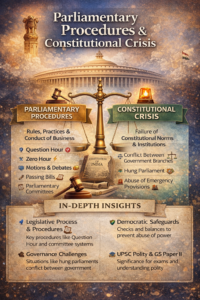

In India, Parliamentary procedures and constitutional provisions form the backbone of democratic governance. Understanding Parliamentary Procedures & Constitutional Crisis is essential for UPSC aspirants, as these topics are frequently tested in Polity and Governance (GS Paper II) and ethics-related case studies.
At times, the breach or mismanagement of parliamentary procedures can lead to a constitutional crisis, threatening the stability of governance and democracy. Understanding both helps aspirants analyze political events critically. 📚

🧩 What are Parliamentary Procedures?
Parliamentary procedures are the rules, practices, and conventions followed in the functioning of the Parliament. They ensure orderly debate, transparency, and accountability in the legislative process.
Key Features:
- Governed by Rules of Procedure and Conduct of Business 📝
- Includes Question Hour, Zero Hour, Motions, and Debates 🗣️
- Ensures legislative accountability of the government
- Regulates introduction, discussion, and passing of bills 📜
Purpose: To maintain discipline, order, and efficiency in parliamentary proceedings.
⚖️ What is a Constitutional Crisis?
A constitutional crisis occurs when constitutional provisions, practices, or institutions fail, leading to conflict between organs of the state. It often arises due to ambiguities, political deadlocks, or violation of constitutional norms.
Examples of Situations Leading to Constitutional Crisis:
- Hung Parliament or coalition breakdown 🤝
- Conflict between President and Prime Minister ⚡
- Judicial review against executive action 🏛️
- Suspension of fundamental rights or emergency provisions 🚨
Purpose of Constitutional Safeguards: To maintain democracy, prevent misuse of power, and ensure smooth governance.
🔹 Key Parliamentary Procedures
1️⃣ Question Hour:
- First hour of Parliament session
- Members ask questions to hold the government accountable ❓
2️⃣ Zero Hour:
- Immediately after Question Hour
- Members raise urgent matters without prior notice ⚡
3️⃣ Motions:
- No-confidence motion: Tests the government’s majority
- Adjournment motion: Highlights urgent issues
4️⃣ Passing of Bills:
- Introduction → Debate → Committee → Approval → President’s Assent 🏛️
5️⃣ Committees:
- Standing Committees monitor government performance
- Select Committees examine bills in detail
🔗 Relationship Between Parliamentary Procedures & Constitutional Crisis
- Failure to follow procedures can trigger a constitutional crisis
- Proper procedures ensure checks and balances
- Courts often intervene to resolve disputes between the legislature and executive
- Ensures democracy is upheld even in political deadlocks 🌟
💡 UPSC Tips
- Memorize key parliamentary terms and procedures
- Study landmark constitutional crises in India (e.g., 1975 Emergency, hung parliaments)
- Link current events to constitutional provisions
- Focus on Article 75, 352, 356, and parliamentary privileges
🚀 Final Thoughts
Understanding Parliamentary Procedures & Constitutional Crisis is crucial for UPSC Mains and interviews. It helps aspirants analyze political, legal, and administrative events with clarity and confidence. 🏛️
❓ FAQs – Parliamentary Procedures & Constitutional Crisis
Q1. What is the main purpose of parliamentary procedures?
To ensure orderly, transparent, and accountable functioning of the Parliament.
Q2. Can constitutional crises be avoided?
Yes, by adhering to the Constitution, parliamentary norms, and democratic conventions.
Q3. Name a major constitutional crisis in India.
The 1975 Emergency and hung parliament scenarios are key examples.
Q4. What is the difference between Question Hour and Zero Hour?
Question Hour: Pre-scheduled questions to hold government accountable.
Zero Hour: Unscheduled urgent issues raised without notice.
Q5. Which articles deal with emergency provisions causing constitutional crisis?
Articles 352, 356, and 360 deal with national, state, and financial emergencies.