
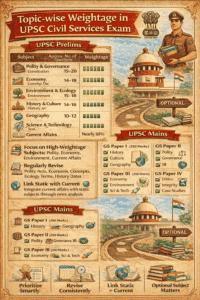

The UPSC Civil Services Examination (CSE) is not just about studying everything under the sun. Smart aspirants focus on topic-wise weightage to understand which subjects and areas carry more importance in Prelims and Mains. Knowing this helps in better time management, focused preparation, and higher scoring potential.
Why Topic-wise Weightage Matters? 🎯
- Helps prioritize high-return topics
- Saves time by avoiding unnecessary over-study
- Improves answer accuracy and confidence
- Essential for strategic revision before the exam
Topic-wise Weightage in UPSC Prelims 📝
📌 General Studies Paper I
1️⃣ Polity & Governance 📜⚖️
- Approx. 15–20 questions
- Constitution, Fundamental Rights, Parliament, Judiciary, Governance
- One of the most scoring & predictable sections
👉 High Priority Subject
2️⃣ Economy 💰📈
- Approx. 14–18 questions
- Budget, Inflation, Banking, Government Schemes, Economic Survey
- Concept + current affairs based
👉 High Weightage & Analytical
3️⃣ Environment & Ecology 🌱🐯
- Approx. 15–18 questions
- Biodiversity, Climate Change, Environment Acts, International conventions
👉 Must-prepare area
4️⃣ History & Culture 🏛️🎨
- Approx. 14–16 questions
- Ancient, Medieval, Modern History & Art and Culture
👉 Static but needs revision
5️⃣ Geography 🌍🗺️
- Approx. 10–12 questions
- Physical, Indian & World Geography
6️⃣ Science & Technology 🔬🚀
- Approx. 8–10 questions
- Space, Biotechnology, IT, Defence
7️⃣ Current Affairs 🗞️🌏
- Integrated across all subjects
- Nearly 40–50% of questions are current-oriented
Topic-wise Weightage in UPSC Mains ✍️📚
📌 General Studies Paper I
- Indian Heritage & Culture
- History
- Geography
👉 Culture and Geography carry significant weight
📌 General Studies Paper II
- Polity
- Governance
- International Relations
👉 One of the most important GS papers
📌 General Studies Paper III
- Economy
- Environment
- Science & Technology
- Disaster Management
👉 Economy + Environment dominate
📌 General Studies Paper IV
- Ethics
- Integrity
- Aptitude
- Case Studies
👉 Conceptual clarity + real-life examples required
Optional Subject Weightage 🎓
- 500 marks total
- Often decides final rank
- Consistent performance in optional gives a big advantage
👉 Choose optional based on interest & syllabus overlap
Interview (Personality Test) 🎤👔
- 275 marks
- Tests attitude, ethics, clarity of thought
- No fixed syllabus but current affairs & background matter
Smart Preparation Strategy Based on Weightage 🧠📌
- Focus more on Polity, Economy, Environment & Current Affairs
- Practice answer writing for GS II & GS III
- Revise high-weightage areas multiple times
- Use previous years’ questions to identify trends
Common Mistakes Aspirants Make ❌
- Ignoring low-interest but high-weightage topics
- Over-focusing on static subjects only
- Not revising important areas enough
Frequently Asked Questions (FAQs) ❓
Q1. Which subject has the highest weightage in UPSC Prelims?
A: Polity, Economy, and Environment usually have the highest weightage.
Q2. Is current affairs really important?
A: Yes. Almost half of Prelims questions are directly or indirectly current-based.
Q3. Does topic-wise weightage change every year?
A: Yes, slightly. UPSC maintains unpredictability, but overall trends remain stable.
Q4. Should I skip low-weightage subjects?
A: No. Cover all subjects, but prioritize high-weightage topics.
Q5. How important is the optional subject?
A: Extremely important. It contributes 500 marks and can decide your rank.
📌 Conclusion
Understanding topic-wise weightage in the UPSC Civil Services Exam is the key to smart and focused preparation. While every topic matters, prioritizing high-weightage areas, linking current affairs, and regular revision can significantly improve your chances of success.