
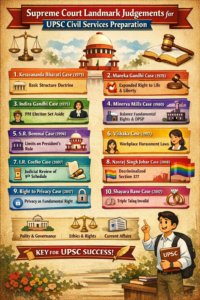

The Supreme Court of India is the apex judicial authority in the country and acts as the guardian of the Constitution. Its judgements have far-reaching implications on law, governance, and society. For UPSC Civil Services aspirants, understanding Supreme Court Landmark Judgements for UPSC Civil Services Preparation is crucial for the Polity, Ethics, and Current Affairs sections. These landmark rulings shape public policy, strengthen fundamental rights, uphold constitutional values, and influence administrative and judicial reforms across India.
Here’s a detailed guide to the most important landmark Supreme Court judgements every UPSC aspirant must know:

1. Kesavananda Bharati vs. State of Kerala (1973) 🏛️
- Significance: Established the “Basic Structure Doctrine”.
- Key Takeaway: Parliament can amend the Constitution, but cannot alter its basic structure (like democracy, secularism, and fundamental rights).
- Relevance for UPSC: Questions on Constitutional amendments, fundamental rights, and judicial review often refer to this case.
2. Maneka Gandhi vs. Union of India (1978) 🚨
- Significance: Expanded Article 21 (Right to Life and Personal Liberty).
- Key Takeaway: Due process under Article 21 must be “just, fair, and reasonable”. Any law affecting life or liberty cannot be arbitrary.
- Relevance: UPSC often links this with personal liberty, civil rights, and administrative law.
3. Indira Gandhi vs. Raj Narain (1975) 👩⚖️
- Significance: Declared the election of the Prime Minister invalid due to electoral malpractices.
- Key Takeaway: Reinforced rule of law and accountability of high office holders.
- Relevance: Shows the Supreme Court’s power in upholding democracy.
4. Minerva Mills vs. Union of India (1980) 🏭
- Significance: Strengthened the Basic Structure Doctrine.
- Key Takeaway: Judicial review cannot be taken away, and the harmony between Fundamental Rights and Directive Principles must be maintained.
- Relevance: Crucial for questions on Constitutional amendments and limits on Parliament’s powers.
5. S.R. Bommai vs. Union of India (1994) 🏢
- Significance: Landmark judgement on federalism and President’s Rule.
- Key Takeaway: Dismissal of state governments under Article 356 is subject to judicial review.
- Relevance: UPSC often asks about federal structure and Centre-State relations.
6. Vishaka vs. State of Rajasthan (1997) 👩💼
- Significance: Laid down guidelines to prevent sexual harassment at the workplace.
- Key Takeaway: Introduced Vishaka Guidelines under Article 21, until legislation (POSH Act) came into force.
- Relevance: Important for questions on women empowerment, workplace rights, and fundamental rights.
7. I.R. Coelho vs. State of Tamil Nadu (2007) 🏛️
- Significance: Affirmed Parliament cannot exclude constitutional review of laws under the Ninth Schedule if it damages the basic structure.
- Key Takeaway: Strengthens judicial review over legislative powers.
- Relevance: UPSC topics: constitutional law, fundamental rights, and Ninth Schedule.
8. Navtej Singh Johar vs. Union of India (2018) 🏳️🌈
- Significance: Decriminalized consensual same-sex relations (Section 377 IPC).
- Key Takeaway: Protects individual dignity, equality, and personal liberty.
- Relevance: Questions on LGBTQ+ rights, constitutional morality, and fundamental rights.
9. Right to Privacy Case (Puttaswamy vs. Union of India, 2017) 🔒
- Significance: Declared Right to Privacy as a fundamental right under Article 21.
- Key Takeaway: Privacy is intrinsic to life and liberty, impacting digital data, personal choices, and governmental surveillance.
- Relevance: UPSC questions: digital privacy, fundamental rights, and civil liberties.
10. Shayara Bano vs. Union of India (2017) 💍
- Significance: Declared Triple Talaq unconstitutional.
- Key Takeaway: Ensured gender equality and protection of fundamental rights for Muslim women.
- Relevance: UPSC often links this with women rights, personal laws, and social justice.
Why UPSC Aspirants Must Focus on Landmark Judgements 📖
- Polity & Governance: Direct questions often come from these cases.
- Ethics Paper: Shows judicial morality, social justice, and constitutional values.
- Current Affairs Linkage: Many judgements are in news for amendments, PILs, and policy changes.
- Essay & GS Papers: Quoting landmark cases adds credibility and depth.
Frequently Asked Questions (FAQs) ❓
Q1. How many landmark judgements should I memorize for UPSC?
A: Focus on at least 10–15 key cases, but understand their principles and implications rather than rote memorization.
Q2. Can Supreme Court judgements change over time?
A: Yes, through reviews, curative petitions, or later judgements. Always check the latest legal status.
Q3. Are these judgements relevant for all UPSC papers?
A: Mostly for Polity, Ethics, GS Paper 2 & 4, and Essay. Some also appear in Current Affairs.
Q4. Should I remember the case name or only the principle?
A: Both are important. Case name + year + principle makes your answer more authentic.
Q5. How can I revise effectively?
A: Create a chart with case name, year, principle, and relevance, and revise it weekly. Use mind maps for connecting cases to topics.